
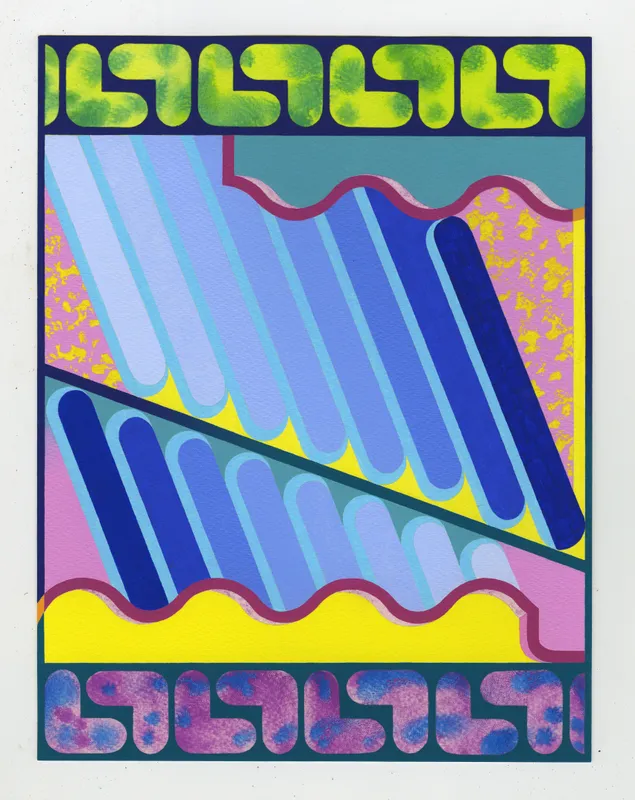
My studio practice is driven by a desire to formulate an abstract visual language that is embedded with markers of personal history and cultural identity. Recent works take the form of three-dimensional paintings and works on paper. The simultaneously discordant and harmonious shapes that play across the surfaces of my work encode reference points drawn from aspects of my Jewish and queer identities, inviting questions about the coordinates where they may intersect.
My studio practice is driven by a desire to formulate an abstract visual language that is embedded with markers of personal history and cultural identity. Recent works take the form of three-dimensional paintings and works on paper. The simultaneously discordant and harmonious shapes that play across the surfaces of my work encode reference points drawn from aspects of my Jewish and queer identities, inviting questions about the coordinates where they may intersect.
In my current sculptural paintings and works on paper, these entangled shapes are themselves echoes of those that appear in eighteenth- and nineteenth-century Eastern European Jewish cut paper works. Made with laborious care by both amateur and professional artists, the central texts that they depicted are typically framed by intricate patterned borders, and were displayed in the home as both ornament and talisman. Taking inspiration from these works is a reclamation, one that seeks to revive a domestic history that was nearly erased by the Second World War. In responding to their forms, my practice envisions what might have been if once thriving Jewish communities in Europe had stayed intact.
A different vernacular of the home–the curvilinear forms of 1980s laminate furnishings–finds its way into my work through an even more personal link. This same furniture was sold by my Jewish, Polish-born grandfather in the store he co-owned on Long Island. In my youth, the stylized dressers and desks that were displayed on the shop floor imprinted on me, in all of their pastel, melamine glory, the wares he sold gave shape to my dreams of vibrant futures.