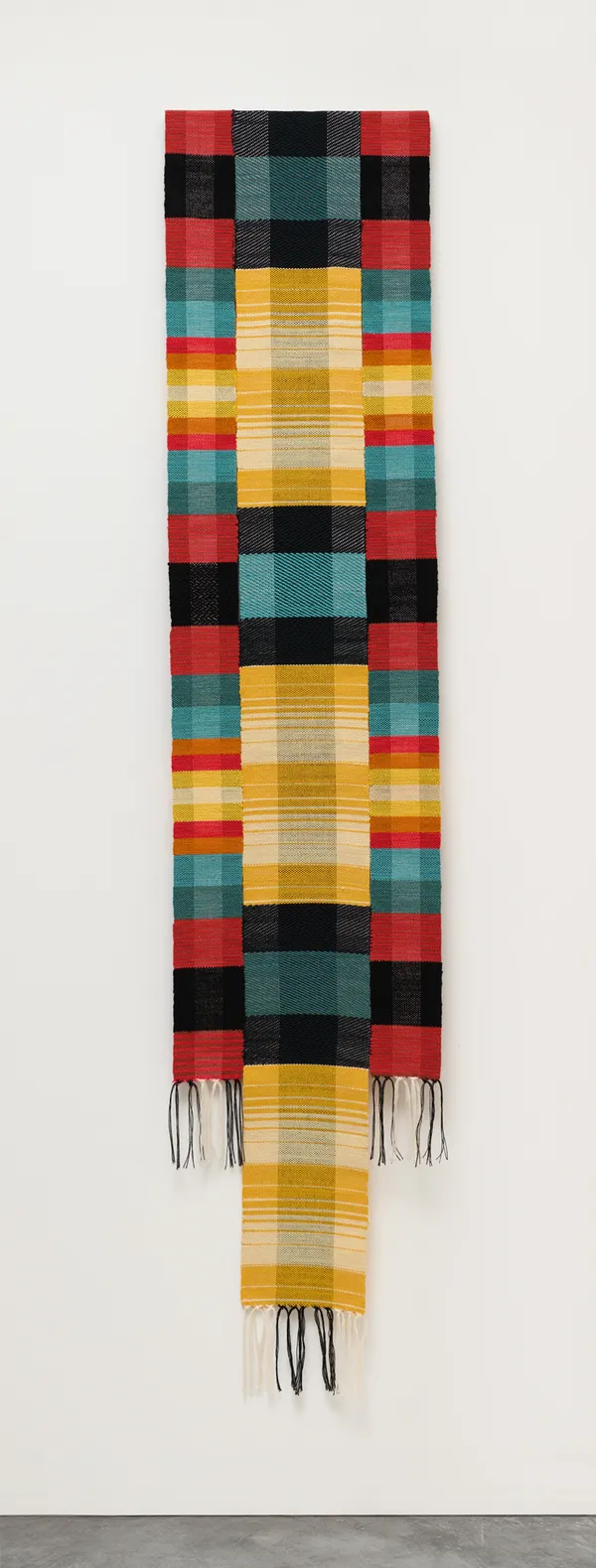

Paolo Arao Philippines, b. 1977
Inversions (Blue), 2026
Cotton double weave on canvas mounted on wood panel
30 × 23 cm | 11 4/5 × 9 1/10 in
signed and dated 2026 verso
In Inversions (Blue), Paolo Arao explores the intersection of painting and textile art through a rigorous and tactile structure.
The work, created with a cotton double weave mounted on a wood panel, reinterprets the language of geometric abstraction through the softness and regularity of the fiber. The composition plays on a grid of rectangles in natural tones of beige, gray, and black, interrupted at the bottom by a series of thin horizontal stripes in cerulean blue that give the piece its title.
This chromatic and formal transition creates a rhythmic, almost musical visual cadence, where the weave of the fabric becomes the primary vehicle of the artistic mark, transforming a common material into a "wall sculpture" that celebrates the precision of contemporary craftsmanship.
In Inversions (Blue), Paolo Arao explores the intersection of painting and textile art through a rigorous and tactile structure.
The work, created with a cotton double weave mounted on a wood panel, reinterprets the language of geometric abstraction through the softness and regularity of the fiber. The composition plays on a grid of rectangles in natural tones of beige, gray, and black, interrupted at the bottom by a series of thin horizontal stripes in cerulean blue that give the piece its title.
This chromatic and formal transition creates a rhythmic, almost musical visual cadence, where the weave of the fabric becomes the primary vehicle of the artistic mark, transforming a common material into a "wall sculpture" that celebrates the precision of contemporary craftsmanship.
1
of
2
Related artworks
-
 Paolo AraoInterval (Radiant), 2026Hand woven cotton and wool206 × 42 cm | 81 1/10 × 16 1/2 in