
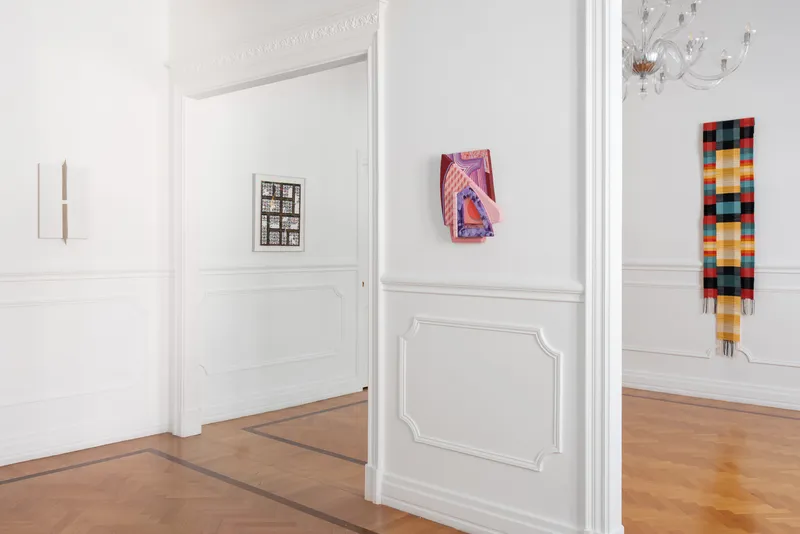
Soft Structures
Paolo Arao | Courtney Childress | Mark Joshua Epstein| Nicholas Moenich | Danielle Mysliwiec | Cyle Warner
Text by Victoria Shimano and Mark Joshua Epstein
Abstraction has often been understood as a language of reduction: a withdrawal from narrative, a movement toward structure, system, and a pure form. Yet the works gathered in Soft Structures suggest something more complex. Across painting, textile, relief, and material construction, these works by Paolo Arao, Courtney Childress, Mark Joshua Epstein, Nicholas Moenich, Danielle Mysliwiec, and Cyle Warner approach abstraction not as a way to articulate an experience. Geometry, repetition, pattern, and chromatic force hold the meaning in suspension, encoding it and then emplifying it.
What emerges across the exhibition is a shared visual thinking. Rather than depicting an essence directly, these artists construct formal systems through which reality evokes. Shape becomes a unit of thought; Color — a declaration; Surface — a site where material, image, and the story meet. The works propose a vocabulary rather than an illustration, and each artist develops that vocabulary according to a distinct internal logic.
The title Soft Structures points to one of the exhibition’s central paradoxes. These works are often rigorous in composition, highly disciplined in process, and deeply invested in the ordering abstraction. Yet they resist an impersonal rhetoric associated with modernist form. The artworks bend toward memory, domesticity, inherited craft, coded identity, and improvisational making. If earlier abstraction often sought autonomy, the works in this exhibition insist on relation to the body, ancestry, labor, and the image-world of the present.
For Mark Joshua Epstein, abstraction becomes a site of material and cultural dialogue. His sculptural paintings and works on paper draw on layered histories of ornament, architecture, and design. The shaped panel in this exhibition enters into conversation with the faux-marble surfaces of Rome’s Baroque churches, where illusionistic pattern blurs distinctions between structure and surface, while his work on paper also echoes the bold, synthetic vocabularies of the Memphis Milano designers.
Across these references, Epstein approaches ornament not as embellishment but as a generative framework—structuring perception while remaining fluid and contingent. He has long drawn on Jewish decorative traditions, particularly eighteenth- and nineteenth-century Eastern European cut-paper works, in which intricate borders activate and frame central forms. Here, that lineage extends into lived space through a site-responsive wall frieze inspired by the Great Synagogue of Florence, translating these concerns into an architectural register.
A similarly charged relation between abstraction, identity, and material memory appears in the work of Paolo Arao, whose textile constructions and sewn paintings are grounded in geometric order while remaining open to rhythm, sensuality, and intimate association. Weaving, for Arao, is not simply a medium but an embodied mode of thought, one linked equally to music and to Filipino textile traditions. His works pulse with repetition, variation, and chromatic intensity. Color operates not as embellishment but as force: spiritual, emotional, protective, and political all at once. Patchworked fabrics, handwoven elements, and traces of garments once worn by family or loved ones transform abstraction into a carrier of lived relation. His compositions are structured, but never inert. They move like scores, or like breath. They invite us to understand pattern as something simultaneously formal and affective, a way of holding memory without fixing it.
In the paintings of Danielle Mysliwiec, the language of abstraction is built through an extraordinary tension between illusion and material fact. Extruding oil paint line by line to mimic the structure of weaving, she produces surfaces that are at once painterly, sculptural, and textile-like. Linen base is an armature— a form-generating presence. Her works delay recognition: what initially appears woven is painted; what appears flat gains volume; what seems decorative opens onto questions of labor and gender. These paintings unfold slowly, changing with light, proximity, and angle. Mysliwiec extends a modernist lineage while quietly undoing some of its hierarchies, reintroducing tactility and handwork not as nostalgic gestures but as active critical terms. In her work, abstraction is not purified; it is thickened, made sensuous, and returned to the body.
If Mysliwiec’s work complicates the relation between painting and textile, Courtney Childress approaches abstraction through a tactile language of childhood memory, bodily sensation, and unstable figuration. Her felted wool paintings occupy a charged zone between play and discipline, spontaneity and repetition. Vaguely recognizable forms drift across the surface: cartoon echoes, anatomical suggestions, traces from domestic and familial life. Yet their softness is deceptive. Needle-felting is an intensely laborious process of repeated puncture, accumulation, and compression. What appears joyful and immediate is built through insistence, physicality, and duration. Childress’s works evoke the sensory worlds of early imagination, where shapes are never entirely settled, and images remain fluid, emotional, and half-formed.
This dimension of transformation is especially resonant in the work of Nicholas Moenich, whose paintings and drawings weave figuration and abstraction into densely psychological spaces. Drawing from medieval illuminated manuscripts, modernist painting, comics, and music, Moenich constructs images that feel simultaneously ancient and hyper-contemporary. Framed and compressed, his compositions are filled with forms that suggest letters, bodies, emblems, and visual fragments without resolving into a stable narrative. Moenich activates a morphology of signs: shapes turn out to be coded characters, shifting across the pictorial field as if participating in a visual tale whose grammar remains obscured. Yet these mythologies reflect on the overstimulation of contemporary perception fractured by screen culture, and the psychic density of living among overlapping image systems.
With Cyle Warner, textiles expand further into space, becoming architectural, mnemonic, and bodily. Drawing on domestic Caribbean environments, Warner treats textiles as a spatial language through which memory is organized and transmitted. His practice approaches the built environment not as a static backdrop but as an active record of touch, movement, communication, and use. Architectural motifs become suits of intimacy; woven structures propose to inhabit space differently. In his work, abstraction is inseparable from proximity. Forms are rather felt as thresholds and passages. The image is no longer confined to the wall; it becomes relational and contingent on the moving body.
Across the exhibition, one further condition binds these artists: a commitment to craftsmanship as thought. Labor is what allows each artist to build a visual vocabulary adequate to the complexity of their concerns. The works insist that form is never only formal. It is worked, negotiated, and accumulated. It carries time.
In an era shaped by the rapid circulation of images, these works also acquire an additional charge. They enter a world in which artworks are seen as a reproduction of reality. Yet rather than denying, they complicate it. They present themselves as visually compelling imagery, while exceeding image through scale, texture, and density. Soft Structures thus proposes abstraction as a mode of relation rather than withdrawal. These artists do not escape the world through form; they rebuild it through form.


