

Installation view of Gaa Gallery’s booth at miart 2026. Courtesy of Gaa Gallery.
The Venice Biennale might be just around the corner, but for this week at least, Milan’s art scene is commanding the spotlight. Under a balmy Po Valley sun, an extensive continental art crowd convened at the hulking Allianz MiCo convention center for miart 2026, the fair’s 30th edition, which opened its VIP day on April 16th.
Much has been made of Milan’s ascent as an art capital in recent years, fueled by a fresh cohort of international galleries opening in the city and talk of international collectors drawn in by Italy’s newly favorable tax regime. Yet miart is not the country’s only major art fair—Artissima in Turin and Arte Fiera in Bologna remain formidable Northern Italian counterparts—so its strength comes from the city’s pull. Collectors from across Europe, it turns out, hardly need persuading to spend time moving between the city’s world-class museums, foundations, and growing clutch of tastemaking galleries, all of which drew strong crowds during a packed Milan Art Week. Underscoring that promise is the arrival this year of trendy alternative fair Paris Internationale, which will host its first edition outside the French capital in Milan’s Palazzo Galbani over the weekend.

Allianz MiCo convention center, the venue of miart 2026. Photo by Nicola Gnesi studio. Courtesy of miart.
This year, miart hosts 160 galleries, down from 179 last year, spread across three maze-like floors of the convention center. Like last week’s EXPO Chicago, that lower number is not necessarily a bad thing. In the fair’s main Established section, booths are spacious and often cross-generational, spanning 20th-century masters and sharper contemporary presentations. The fair also shows a clear appetite for the new. That is especially evident in the fair’s Emergent section dedicated to young galleries, which has grown to 26 exhibitors from 20 last year.
So yes, there are plenty of works by Lucio Fontana, Giorgio de Chirico, and Giorgio Morandi on view—but also booths that take a more international and contemporary outlook. London’s influence is especially notable this year: Ginny on Frederick and Rose Easton join the main section alongside debutant Soft Opening and returning exhibitor Sadie Coles HQ, while Emergent includes younger galleries such as Des Bains, Ilenia, and South Parade.

Installation view of Cardi Gallery’s booth at miart 2026. Photo by Nicola Gnesi studio. Courtesy of miart.
By the fair’s opening hours, the VIP crowd seemed relaxed, and several were ready to buy. “I come to miart every year because it’s a great place to discover gems by major Italian artists as well as masterpieces by artists who are little known outside of the Italian context,” said London advisor Daniel Malarkey, who had bought two works within 20 minutes of the fair’s opening. Having arrived from Mona Hatoum and Cao Fei exhibitions at Fondazione Prada, he pointed to the broader pull of the city itself. “It’s definitely an unmissable time to come to Milan,” he said.
Here, we present the five best booths from miart 2026.
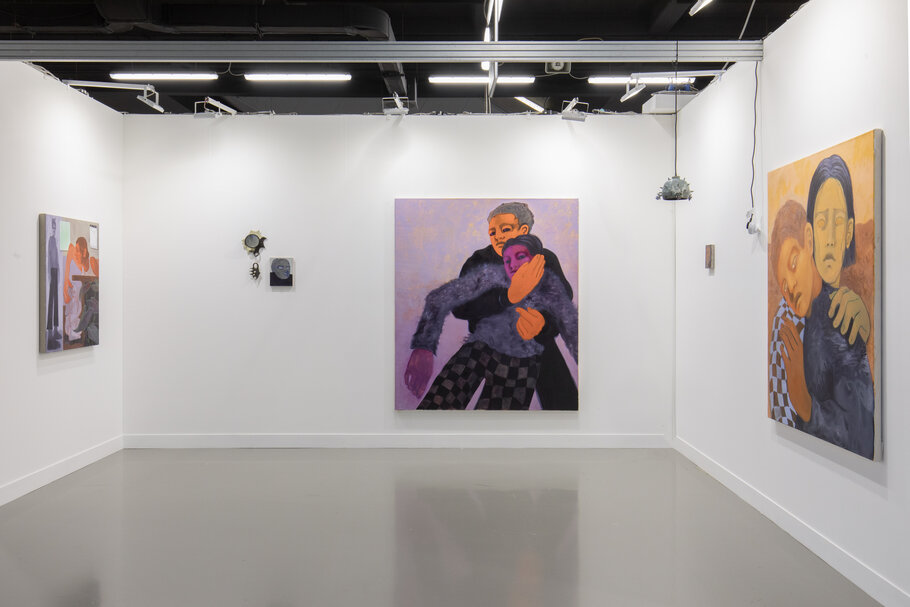
Installation view of Gaa Gallery’s booth at miart 2026. Courtesy of Gaa Gallery.

In Katja Farin’s paintings, bodies bend, glow, and distort. In a series of new works presented by New York and Cologne space Gaa Gallery, the American artist turns to the idea of care. These paintings are intended to explore, as the artist told Artsy, “holding patterns, how we hold each other and the expectations that come with either care or needing care.”
The encounters portrayed here feel at once intimate and estranged. In Moment of Touch (2025), an orange figure leans over a pale, loosely articulated body, its elongated arm wrapping around the smaller form in a gesture that reads as protective, controlling, or both. A ghostly grayscale figure hovers behind them, turning a domestic space into an ambiguous drama.
“Either you’re the person being held, or you’re the person holding, and [there’s an] emotional weight that comes with both of those things,” Farin added. A group of ceramics extends that tension into three dimensions: Mottled vessels bristle with spikes and protrusions, as though growing limbs or priming their own defenses. Paintings on the booth range in price from €1,500 ($1,766) to €16,000 ($18,845), with ceramic works priced at “around” €1,000 ($1,177).
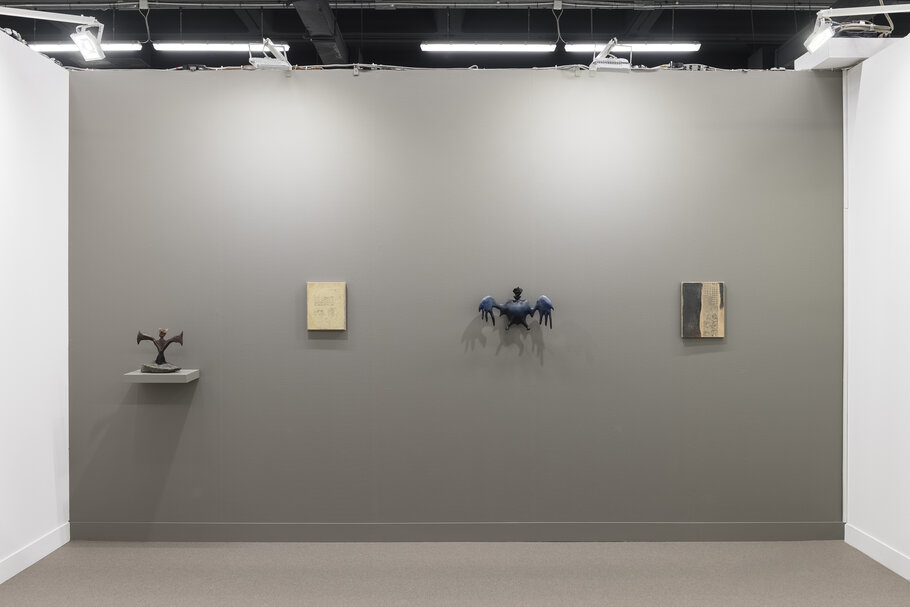
Installation view of Andrea Festa Fine Art’s booth at miart 2026. Courtesy of Andrea Festa Fine Art.
Rome gallery Andrea Festa Fine Art’s presentation, “One’s Natural Habitat,” pairs Brazilian artist Pedro Liñares’s hushed, elusive paintings with French artist Leo Orta’s uncanny sculptures in a booth that rewards slow looking. Despite their different media, both artists share an interest in how forms emerge through time and perception.
Liñares’s paintings are created by accumulating and then erasing pigment, drawing on domestic ornament and architectural fragments. In the abstract, minimal work Motivo 1 (2026), for instance, a pale vertical band marked with patterned geometrical motifs hovers against a black, worked surface that seems almost weathered into being.
Orta’s work, by contrast, pushes outward into space. His pint-sized, hybrid “Bat Sculpt” forms, made from salvaged materials including lava stone, appear to sprout from rough, branching clay supports. In BAT Sculpt #8 (2026), a porous black form reads as both bodily and architectural, as though testing how it might inhabit its surroundings.
“They’ve both been interested in this organic world,” said gallery director Victoria Shimano. “They highlight each other—they don’t interrupt each other.” Works on the booth range in price from €1,800 to €5,500 ($2,120 to $6,478).
Booth C02
With works by Helene Appel, Riccardo Baruzzi, Irma Blank, Adelaide Cioni, June Crespo, Victor Fotso Nyie, Paolo Icaro, Merlin James, Khaled Jarada, Xian Kim, Francis Offman, Alessandro Pessoli, Alessandra Spranzi, Monika Stricker, Franco Vaccari, Pieter Vermeersch, and Shafei Xia.
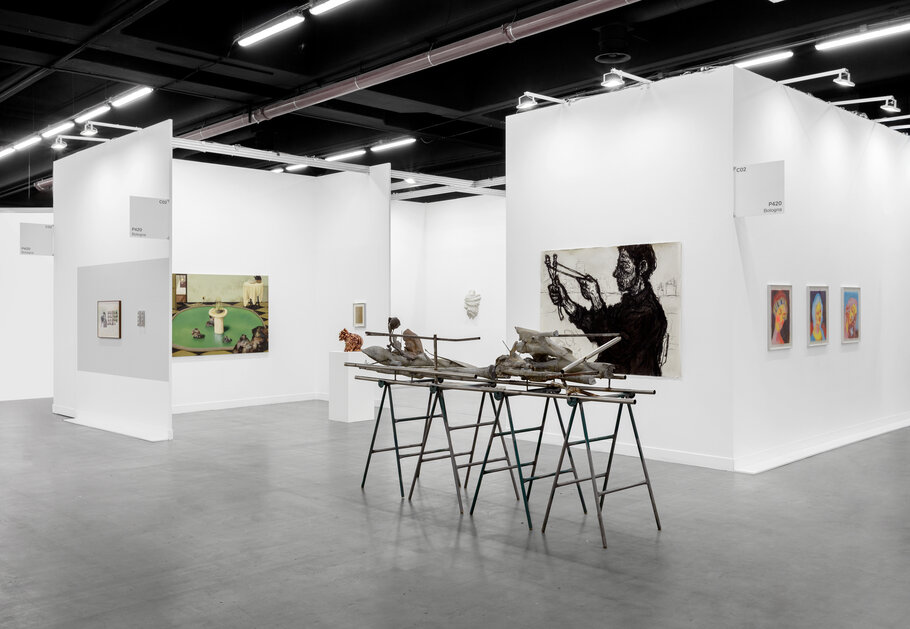
Installation view of P420’s booth at miart 2026. Photo by S.Pellion di Persano. Courtesy P420, Bologna.

Bologna tastemaker P420 brings the full heft of its roster to miart in a smart presentation showcasing different media, scales, and generations.
That breadth is immediately apparent in the pairing of two standout works at the front of the booth: Khaled Jarada’s Remaining Gesture (2026) and June Crespo’s Traction III (2025). Jarada’s dark, expressive charcoal of a man with a slingshot is raw and poignant. Crespo’s low, horizontal sculpture, by contrast, consists of four sawhorses with cement sculptures resting on top, evoking both bones and DIY tools.
Elsewhere, Helene Appel’s acrylic and oil painting Sink (with dishes) (2026) offers a quiet but exacting meditation on the everyday, while Alessandro Pessoli’s Vergine fiorentina (2026), a small acrylic portrait work, evokes religious intensity on the booth’s exterior.
With prices ranging from €8,000 ($9,423) to €45,000 ($53,005), the gallery struck an optimistic tone early in the VIP day. Gallery co-founder Alessandro Pasotti noted the presence of many of their regular collectors as well as “very good international collectors.”
Booth C02-C04
With works by Arturo Martini, Marino Marini, Lucio Fontana, Ettore Spalletti, Michelangelo Pistoletto, Piero Manzoni, Carla Accardi, Tancredi, Giorgio de Chirico, Jannis Kounellis, and Giorgio Morandi.
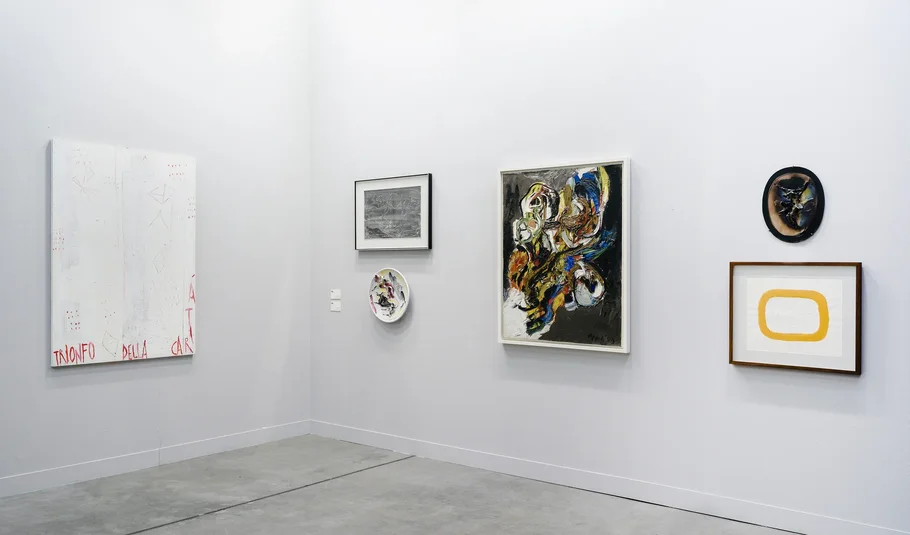
Installation view of ML Fine Art (Matteo Lampertico)’s booth at miart 2026. Courtesy of ML Fine Art (Matteo Lampertico).
Situated on the top floor of the convention center in miart’s Established Anthology section—dedicated to presentations that display the “complexity, trajectories, and transformations of time”—ML Fine Art’s bumper booth does exactly what the section promises. The local stalwart presents a tightly curated survey of 20th-century Italian art, bringing works from its various movements—post-war, conceptual, and Arte Povera—into crisp relation.
The gallery deftly stages a series of smart conversations between works: A restrained Giorgio Morandi landscape hangs near a sparingly depicted Giorgio de Chirico cityscape (both works are priced in the mid six-figures apiece), while Carla Accardi’s rhythmic abstraction plays off Lucio Fontana’s spatial rupture. The result is a presentation that comes across as an active correspondence across movements.
This is a booth built on confidence in the work itself. At a fair increasingly defined by its contemporary edge, the gallery’s top-quality display is a reminder of miart’s enduring strength in historical Italian art—work that, when installed with rigor, can feel as urgent as anything made now.
Booth F17
With works by Carla Badiali, Alberto Biasi, Gianni Bertini, Martha Boto, Giosetta Fioroni, Agostino Iacurci, Emilio Isgrò, William Klein, Antonio Marras, Nino Migliori, Maria Lai, Marco Petrus, Ming Smith, Tino Stefanoni, Grazia Varisco, and Nanda Vigo.
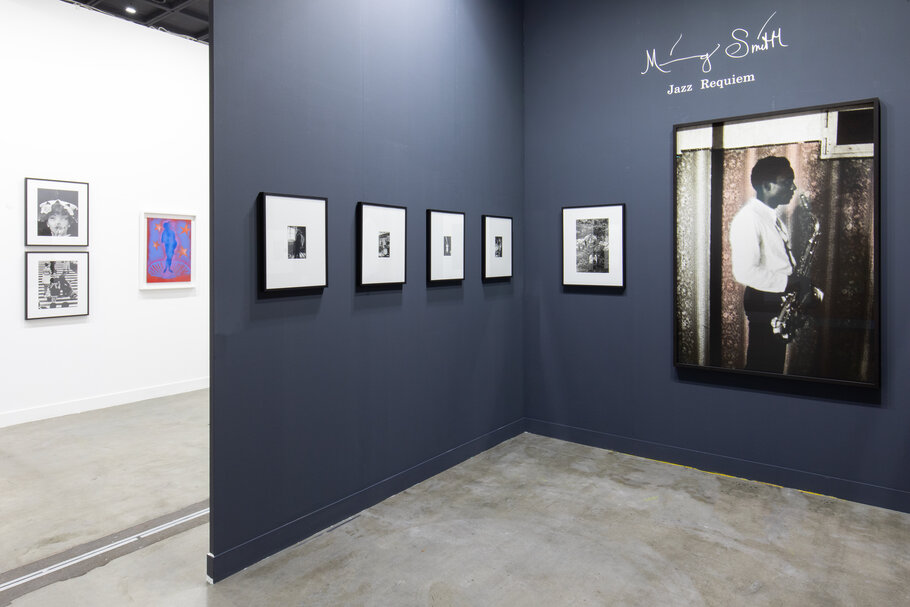
Installation view of M77 Gallery’s booth at miart 2026. Courtesy M77 Gallery.

M77’s booth is one of the fair’s most cohesive group presentations, using “New Directions”—the fair’s John Coltrane–inspired theme for this edition—as its organizing principle. Moving across generations and media, the booth maintains a sense of rhythm, improvisation, and syncopation.
That musical reference is most explicit in the special focus on Ming Smith. Installed against a dark blue wall under the title “Jazz Requiem,” her photographs translate jazz into visual form. Not just documenting musicians, Smith’s images channel the musical genre through blur, grain, shadow, and atmosphere. Her David Murray (1993–94), a vintage gelatin silver print of the saxophonist mid-performance, renders him as a dark, almost silhouetted presence. The result is less a straightforward portrait than a meditation on presence, performance, and spontaneity. M77 managing director Chiara Principe noted that Smith started photographing in the 1970s and was the first Black woman artist whose work was acquired by MoMA.
Elsewhere, the booth moves through very different registers. William Klein’s monochrome photograph Hat + 5 roses, Paris (1956) captures a woman in a dramatic floral hat smoking directly into the frame, her face partially veiled by drifting smoke; the image has the touching playfulness that made Klein such an influential photographic force. Agostino Iacurci’s painting When the Cactus is in Bloom 11 (2026), by contrast, introduces a brighter, more graphic tempo, with five cactus forms rising in strict vertical sequence against a pink ground. Works at the booth range from €5,000 ($5,889) to €150,000 ($176,686).

